Why Particle Accelerators Buy Almost No REBCO Tape
Particle accelerators spend heavily on superconductor, and almost none of it reaches rare-earth barium copper oxide (REBCO) tape, the material this site follows. The magnets were won decades ago by older metal alloys, and CERN’s largest recent conductor order, 1,450 km of wire for the High-Luminosity Large Hadron Collider, went to a competing material. For tape makers this is a small, slow, publicly funded segment whose real revenue case sits a decade away and is not yet funded.
The magnets were won by an older material and are not in play
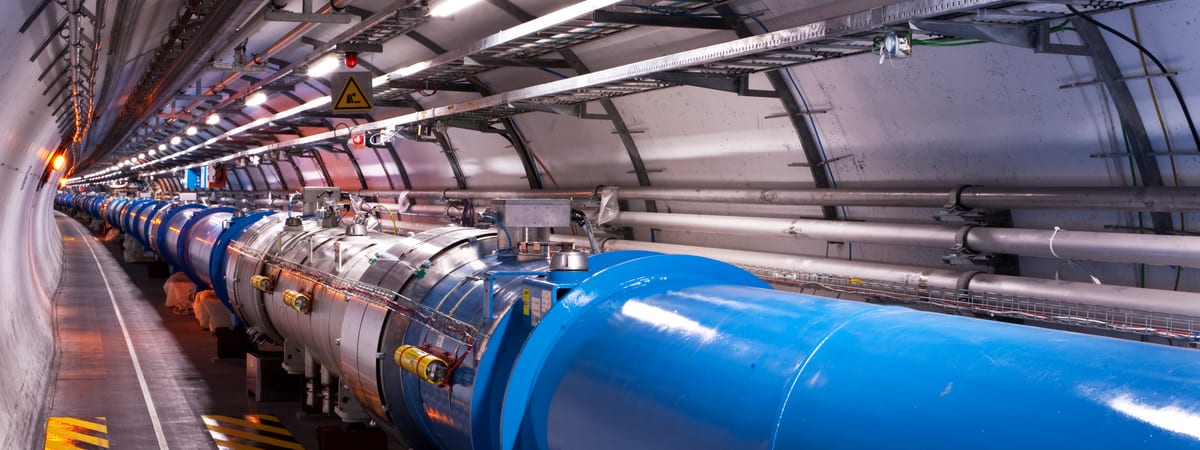
The Large Hadron Collider (LHC) steers its beams with 1,232 magnets, each 15 metres long and weighing 35 tonnes. They are wound from niobium-titanium, a metal alloy that must be held at 1.9 K in liquid helium, which takes 120 tonnes of it. It is the same conductor that runs hospital scanners, as our article on medical imaging explains. When CERN needed something stronger for its High-Luminosity upgrade, it chose niobium-tin, another alloy of the same generation.
The commercial point is that these machines were designed around conductor that works, and nothing forces a change. Accelerator magnets are not an addressable market for REBCO tape.
CERN’s biggest recent conductor order went to a competitor
Accelerators do have a newer need. Current has to travel from the power supplies to magnets sitting in the tunnel, and CERN built flexible superconducting links to carry it: 19 cables in a single bundle, each about 140 metres long, together carrying about 120,000 amps at 25 K. Ten are being built, and the first complete system passed its tests in May 2024.
The conductor is magnesium diboride, not tape. ASG Superconductors finished 1,450 km of it in October 2023. The entire REBCO tape industry produces about 5,000 km a year across roughly 15 manufacturers. So a single accelerator programme placed an order worth more than a quarter of a year of world tape output, and a rival material took all of it.
”High-temperature” in a laboratory announcement can mean a rival material
CERN calls those cables high-temperature superconducting and says why: the system runs at up to 60 K, against 1.9 K for the magnets. Measured against liquid helium, that is fair.
This site draws the line at 77 K, the point above which cooling can be done with liquid nitrogen and stops needing specialist equipment. Magnesium diboride superconducts at 39 K, so it does not clear that bar, and it is made as round wire in different factories, by different companies, from REBCO tape.
The rule for reading announcements: an accelerator link described as high-temperature superconducting may well be a competitor’s win, and those kilometres do not belong in a tape forecast. Our guide to superconductor chemistries sets out which material is which.
REBCO tape’s position here is small and strategic
Tape is in the CERN link, in one place. REBCO cables carry the current from 20 K up to 50 K, the stretch where no cheaper conductor works, before ordinary connections take it the rest of the way to room temperature.
The volume is negligible against 1,450 km of wire. The value is a reference: REBCO tape working in the world’s most visible physics machine, with published results. That matters when selling to other conservative, engineering-led buyers.
The revenue case rests on machines nobody has funded
Proposed future colliders would change the arithmetic. Muon collider studies make high-temperature superconductor the technology for every superconducting magnet, running at 20 K. The economics are improving too. A 2026 review by CERN magnet engineers finds REBCO already approaching niobium-tin on cost per unit of current, with a further reduction by a factor of three expected as manufacturers expand capacity, and measures a fourfold saving in cooling energy from running at 15 K to 20 K instead of 4.2 K.
Timing is the catch. The same muon collider roadmap rates these magnets at an early laboratory stage against near-ready for niobium-titanium, expects the work to continue past its own ten-year window, and costs it at roughly 83 million Swiss francs and 400 person-years, for a machine no government has approved.
What to put in a forecast
Accelerators are slow, publicly funded and unusually predictable. Requirements are published years in advance and the funding cycle has nothing to do with fusion, so nothing here moves on a quarterly result.
Near-term tape revenue, though, is small: current leads and research magnets, not kilometres of cable. Treat accelerators as the place where high-field REBCO magnets get proven, and as a market tape has to win back from magnesium diboride, rather than as volume. The applications that consume tape today are set out in where the tape goes.